The Best Social Deduction Games by Group Size
Running a game night with fewer than a dozen people is often the right size. Here, I’ll talk about a few of the most popular options available along with some of my lesser-known favorites. These are the best social deduction games, and they’re broken down by player size.
What Is a Social Deduction Game?
Before I get into the details for each of the games, I wanted to answer the biggest question first. What is a social deduction game? Social deduction games give players competing motivations and encourage deception by at least some of those involved. The remaining players try to uncover the motives of the other players (often while trying to complete a shared goal). The category includes long-time in-person favorites like Werewolf and Mafia. It also includes modern video games like Among Us.
| Two players | Inhuman Conditions |
|---|---|
| Five players | Secret Hitler, The Resistance |
| Exactly six players | The Elderflower Inn |
| Six or more | Werewolf (Mafia), with a moderator |
| Best for | Uncovering hidden motives and light roleplaying at the table |
Let’s start with the elephant, er lycanthrope, in the room.
Werewolf (Mafia)
The best known example of a social deduction game is likely Werewolf. That’s the name I know it by, but many people learned the game as Mafia. Both versions follow similar rules, and both have variations that add additional complexity. There’s even a research paper about strategies for these factions.
Werewolf is a game with two teams: villagers and werewolves. The game takes place in two phases. During the night, werewolves choose a villager to eliminate. During the day, the villagers choose a player they think might be a werewolf and eliminate them. If the villagers eliminate all the werewolves, they win. If not, the werewolves win. That’s the simple version. And Mafia is played the same way but with villagers against members of the mafia.
I mentioned spinoffs of Werewolf and Mafia. Ultimate Werewolf (or Werewolf Ultimate) is one of them I found in my games closet. It’s handy for those who want to play a more advanced version of the game with extra roles and cards for role assignments.
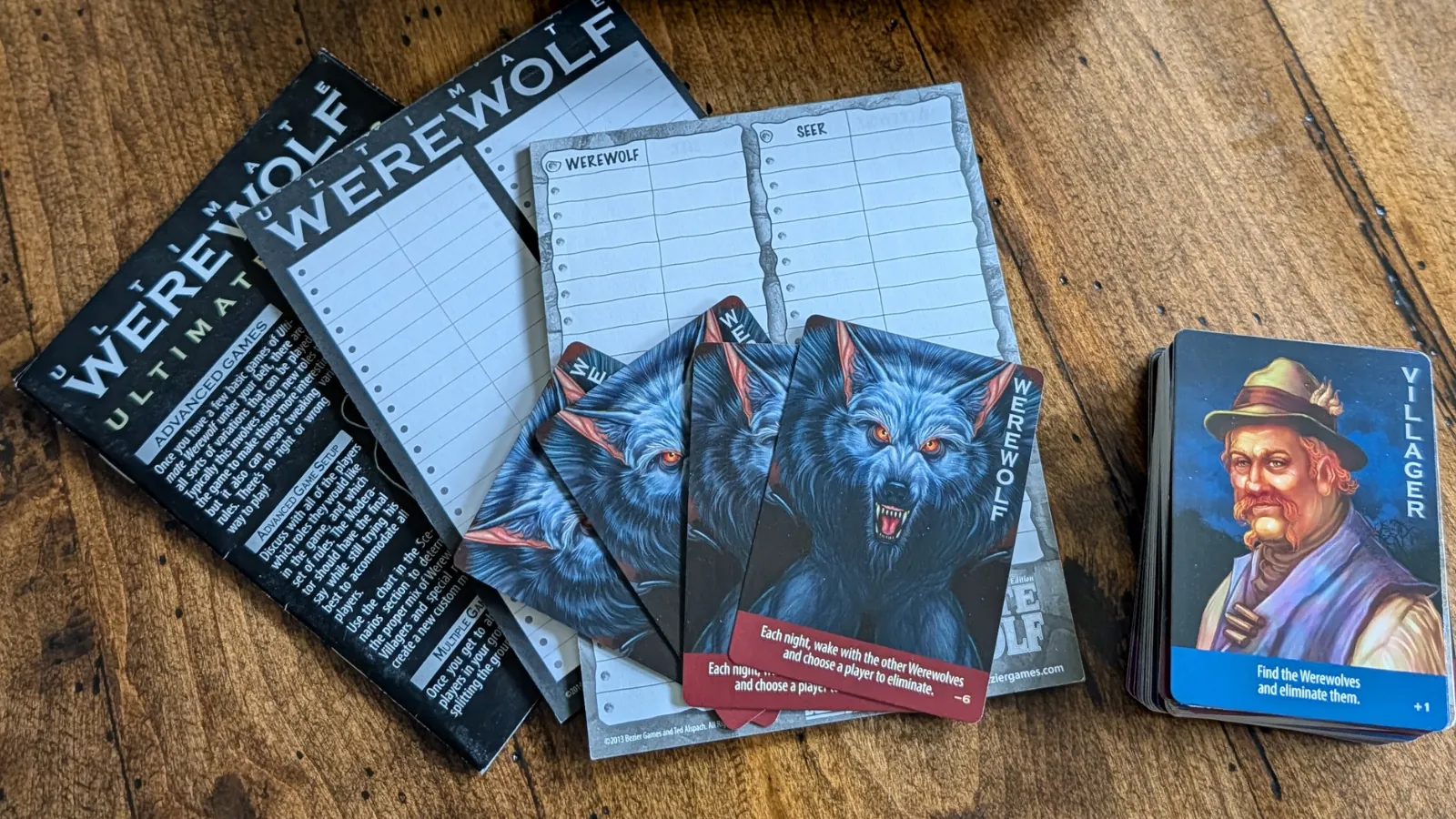
Both games work with big groups of people. That’s one reason they’re so common at gaming conventions like Gen Con. I’ve played Werewolf in comic book shops, game stores, and conventions. It’s a go-to choice when you have a moderator and a group of at least six players.
Social Deduction Games for Five Players
Not all social deduction games need large groups. Secret Hitler and The Resistance are both wildly popular tabletop social deduction games, and both of them work with as few as five players. I first played Secret Hitler when it was still in development. We played in the Cards Against Humanity headquarters, in one of the conference rooms, and we had six people around the table at the time.
Social Deduction Games for Small Groups
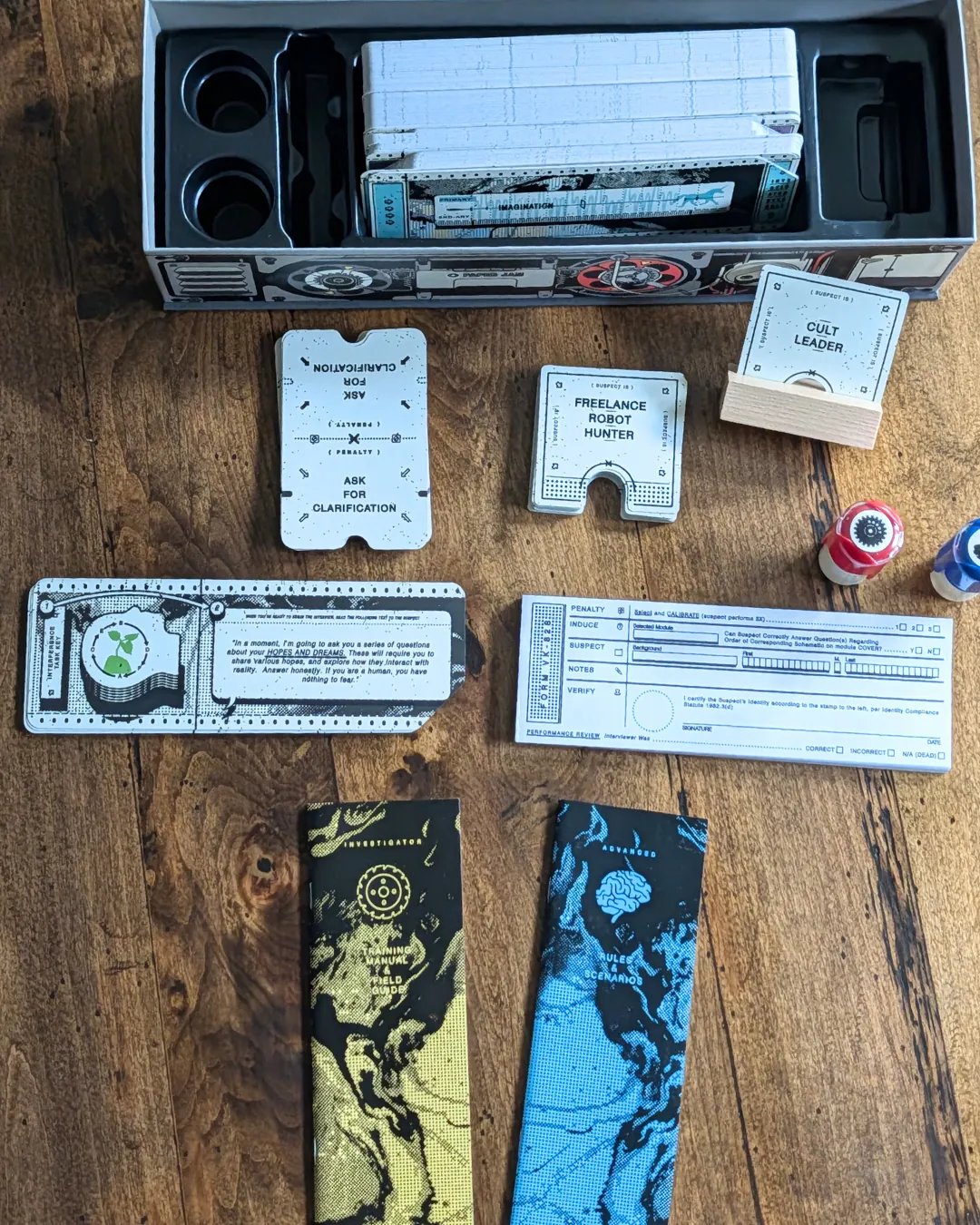
Some social deduction games work with even smaller groups. My favorite for two players is Inhuman Conditions. I played it numerous times, including in a busy convention hall at Gen Con, and it worked just as well with a group of people as it did with just two people.

If you haven’t played, here’s the 30-second overview. Inhuman Conditions is basically an interview game where one person grills the other person about whether they’re a human or a robot. The interviewee might be either (they have certain restrictions if they’re a robot) and want to prove their humanity in order to survive.
I adore this game.
It’s rare to find a social deduction game that only requires two players, and it requires so much creativity from each player through the entire round. It also came out before the advent of modern AI and seems more prescient every year.
Parlor Larp Social Deduction Games
I’ve heard someone describe parlor larps as TTRPGs standing up. That sounds about right. I’m a sucker for stand-up-and-play games, and I especially love a mystery larp. That’s why I designed The Elderflower Inn. It’s a financial mystery (instead of a traditional murder mystery) for exactly six players. Each character has public and secret goals, and the shared goal is a cozy whodunit.
This is what I’m playing with my friends right now. I had a public playtest in Highland Park a few weeks ago, and I have another game scheduled for tomorrow night. It has been such a joy to see people embody the characters each time.

Unlike Secret Hitler or The Resistance, The Elderflower Inn doesn’t use cards or a tabletop structure to keep everyone in one place. It assumes people will have private conversations and eventually come together to vote on who they think stole the money.
Why These Are the Games I Recommend
Over the past few decades, I’ve attended game conventions across the United States. I’ve run my own events at many of these, usually competitive writing duels, and played countless games. So I’ve developed a palate. Some of my favorites are social deduction games. If you’re interested in uncovering hidden motives and light roleplaying at the table, these are the games I’d recommend. I’m including anything I would find helpful if I was looking for options, so I hope you can find everything you need.
More from Autumnal Games
- Crypt Kickers, a free committee larp, and a good first game for a group that has never played
- Social deduction and party games, the full reference table, filterable by player count and run time
- Browse all our games, or warm up with a free puzzle
Frequently asked questions
What is a social deduction game?
Social deduction games give players competing motivations and encourage deception by at least some of the people involved. The remaining players try to uncover the motives of the others, often while working toward a shared goal. The category covers long-time in-person favorites like Werewolf and Mafia, and it also covers modern video games like Among Us.
How many players do you need for Werewolf or Mafia?
Werewolf and Mafia are a go-to choice when you have a moderator and a group of at least six players. Both also work with big groups, which is one reason they are so common at gaming conventions.
What social deduction games work with five players?
Secret Hitler and The Resistance are both wildly popular tabletop social deduction games, and both of them work with as few as five players.
Are Werewolf and Mafia the same game?
They are close. Both versions follow similar rules, and both have variations that add additional complexity. Werewolf sets villagers against werewolves and Mafia sets villagers against members of the mafia, but the night and day structure is the same.
What is a parlor larp?
Parlor larps are small live-action roleplaying games that can happen in a few rooms. They're often similar to tabletop RPGs in content, but you move around beyond the table and stay in character during play.
Are there social deduction video games?
Yes. Among Us is the best known modern video game in the category, and it works from the same core idea as in-person favorites like Werewolf and Mafia.

Jim makes games and events that invite people to embrace a shared fiction.