The best murder mystery party kits for adults
The best murder mystery party kit is the one that fits the people on your guest list. You've got to consider the players first. I've designed and played these games for years, from one-room parlor larps to events with more than thirty players, and the right kit for your party depends almost entirely on who's coming.
If you want the short answer, it's Arsenic and Lies. It's the best overall option right now. Below, I'll tell you why, what these kits cost, where I actually buy them, and which boxed games I'd skip.
| Best overall | Arsenic and Lies, a card-based game with no game master and no prep |
|---|---|
| Cost | $10 to $20 for a used boxed game, $15 to $50 for a vintage How to Host a Mystery, $25 plus shipping for a new card kit |
| Group size | 5 to 10 for most boxed and card kits; scales past 30 for events |
| Run time | An evening (about three hours for a card kit like Arsenic and Lies) |
| Where to buy | eBay, estate sales, and the designers themselves |
| How to choose | By the people on your guest list, not the theme |
In college, a friend and I wrote a murder mystery set at Villandry, a château in France we'd visited together on a study abroad program. We worked on it for a month and ran it once, on the grass at a park in Tours, for the friends who'd been on that trip with us. We had baguettes, cheese, and wine. I still have a copy in a box somewhere.
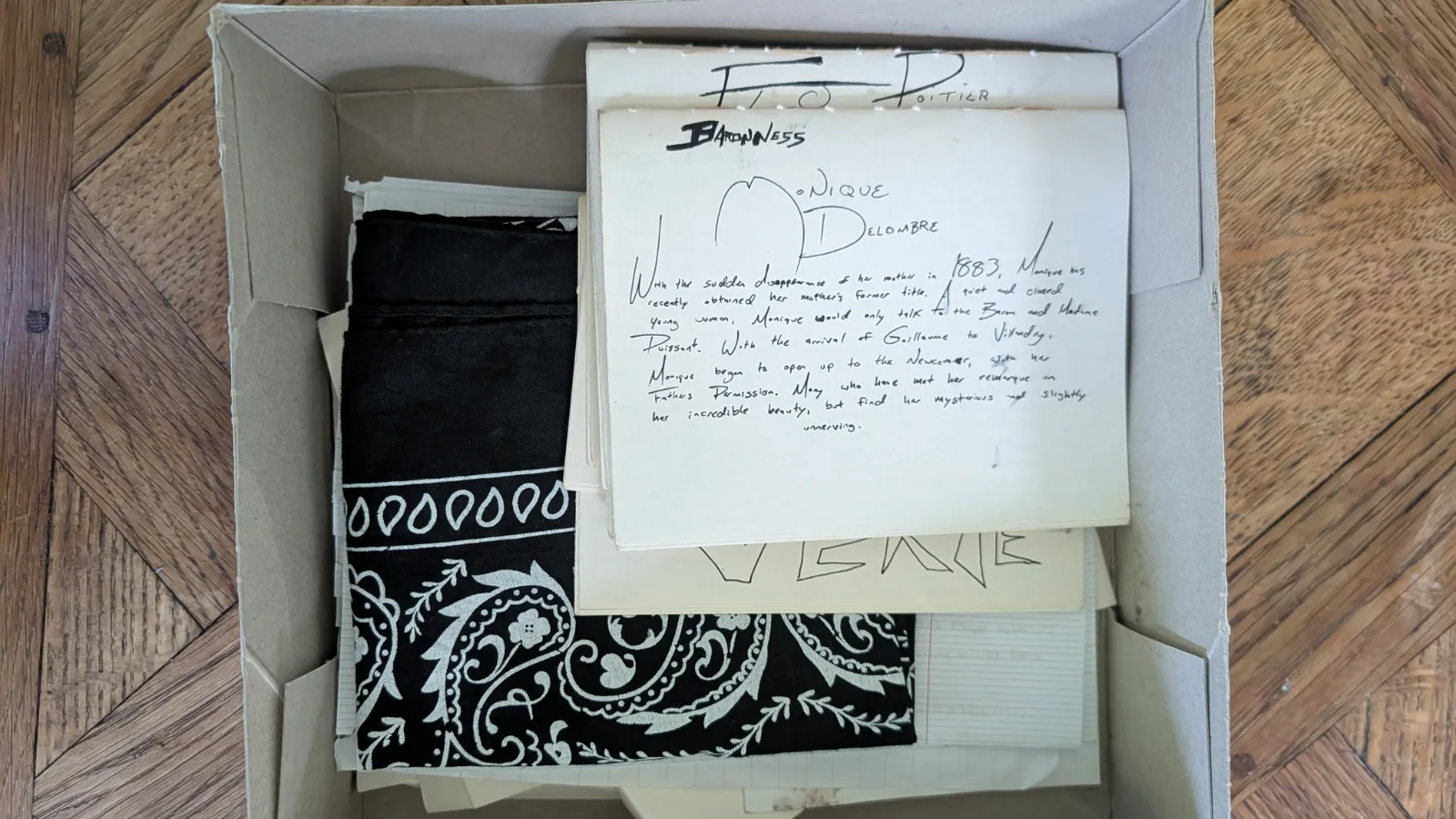
What I remember most is watching people I only knew from the program become entirely different people for an afternoon. The characters we handed them came with limitations, and those limitations freed everyone. My friends made choices they'd never have made as themselves, and that's still my favorite part of play.
That afternoon taught me the most important thing I needed to know about murder mystery games. The kit matters less than the fit, and everything below follows from that.
The best murder mystery party kit depends on your group
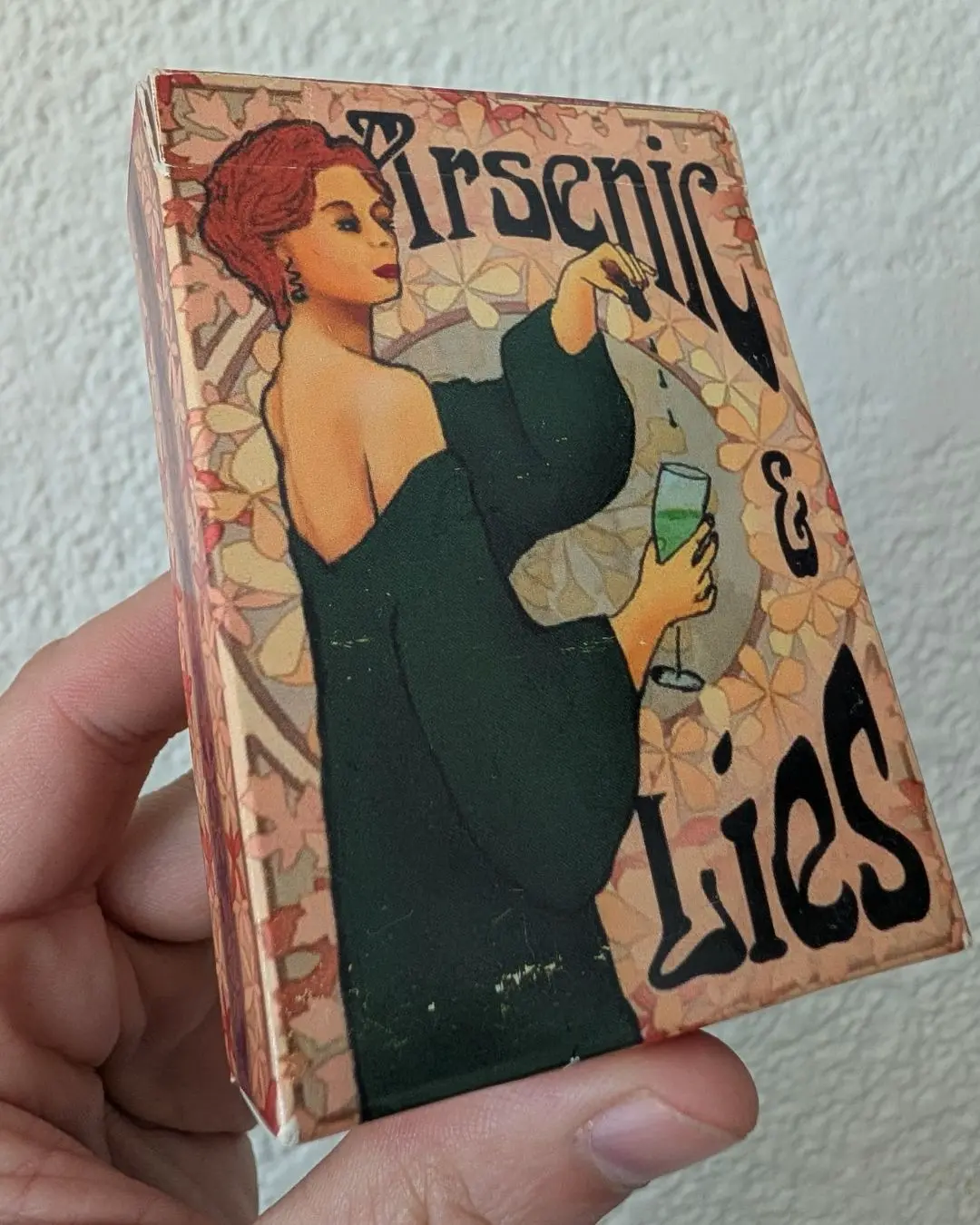
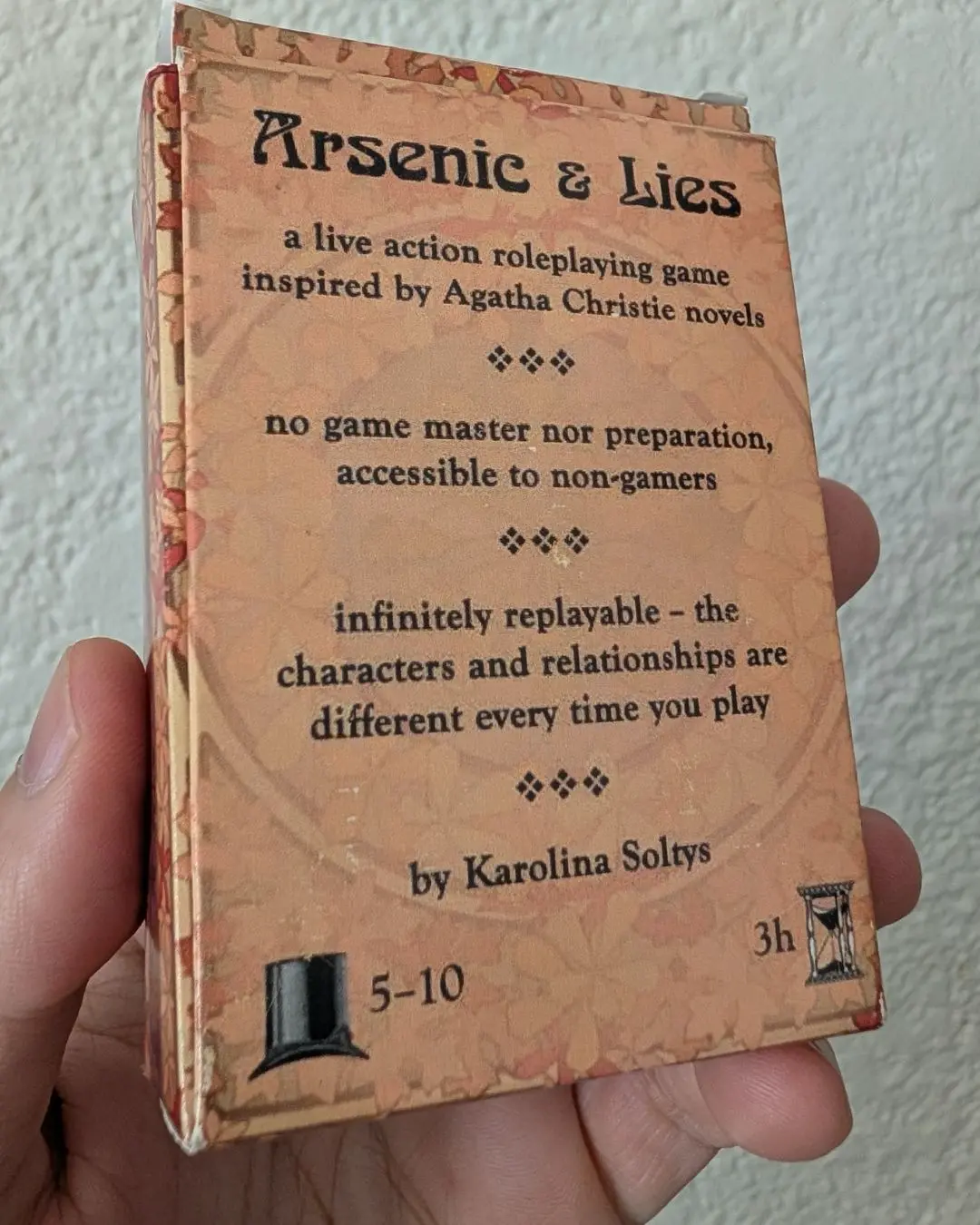
Arsenic and Lies by Karolina Soltys is one of my favorite easy-to-play murder mysteries, and it's the one I'd hand most adults. The whole game is a deck of cards, and you can run a full mystery in an evening. I've played it more than once, and it was fun each time. It sits comfortably in that middle band: structured enough to guide the night, open enough that players get to be people instead of scripts.
It's $25 plus shipping for the physical deck, with a cheaper print-and-play PDF if you'd rather print at home. No game master, no prep, 5 to 10 players, about three hours.
That recommendation may change with the growth of jubensha and jubensha-style games in the US. It's the most interesting thing happening in the genre right now, and I expect the shelf to look different in a few years.
How much a murder mystery party kit costs
Most people should expect to spend between ten and thirty dollars. You can also spend nothing.
Old How to Host a Mystery boxes turn up on eBay, often used and sometimes unused. Prices range from about $15 to $50, including shipping in the United States. There are many, many more from other brands for $10 to $20, including shipping. That's the cheapest way into the traditional scripted style, and the games still work.
A new card kit like Arsenic and Lies runs $25 plus shipping, or less as a print-and-play PDF. That's the sweet spot for most parties, and it's where I'd start if you're buying new.
Join the Harvesters
Early access to new games, playtests, and exclusive events from Autumnal Games.
Where to buy murder mystery party kits
I get murder mysteries from estate sales, eBay, and from the game designers themselves.
eBay is where the old boxed games live. Estate sales are the same story with better prices and worse odds. Buying direct from designers is how you find the newer independent games, the ones that never make it onto a shelf.
I'm always surprised when I see them at big box stores. They're out there. I wouldn't plan a party around finding one.
One thing worth knowing before you buy a used box. Missing pieces are less fatal than they sound, because the game community tends to be super helpful. Here's an old thread where someone provided a missing clue for a decades-old murder mystery game. If your box is short a card, ask.
The murder mystery kits I'd avoid
I'd avoid some of the 1990s murder mystery boxes if I wanted to play with my friends. They're usually structurally sound, so you'll figure out whodunit, but they're also super uncomfortable.
If you want an example of what they look like, there's an episode of The Office where they play one. It's a pretty good example of how to use one of those boxed murder mystery games right.
Does the theme of a murder mystery kit matter?
I'm theme agnostic, and I'd encourage you to be too when you're judging a kit.
The theme might be the single most compelling thing people consider when buying a murder mystery game. It's what gets your attention on the shelf. It's what you imagine when you picture the party ahead of time. But the theme is also the easiest thing to get right as a game designer. If you're interested in the setting, it's not hard to layer that onto a murder mystery structure.
So pick the 1920s one, or the western one, or the Halloween one. Pick whichever setting makes you want to throw the party. Then judge the game on the structure underneath it, because that's the hard part, and it's the part that decides whether your night works.
Murder mystery kits vary in major ways
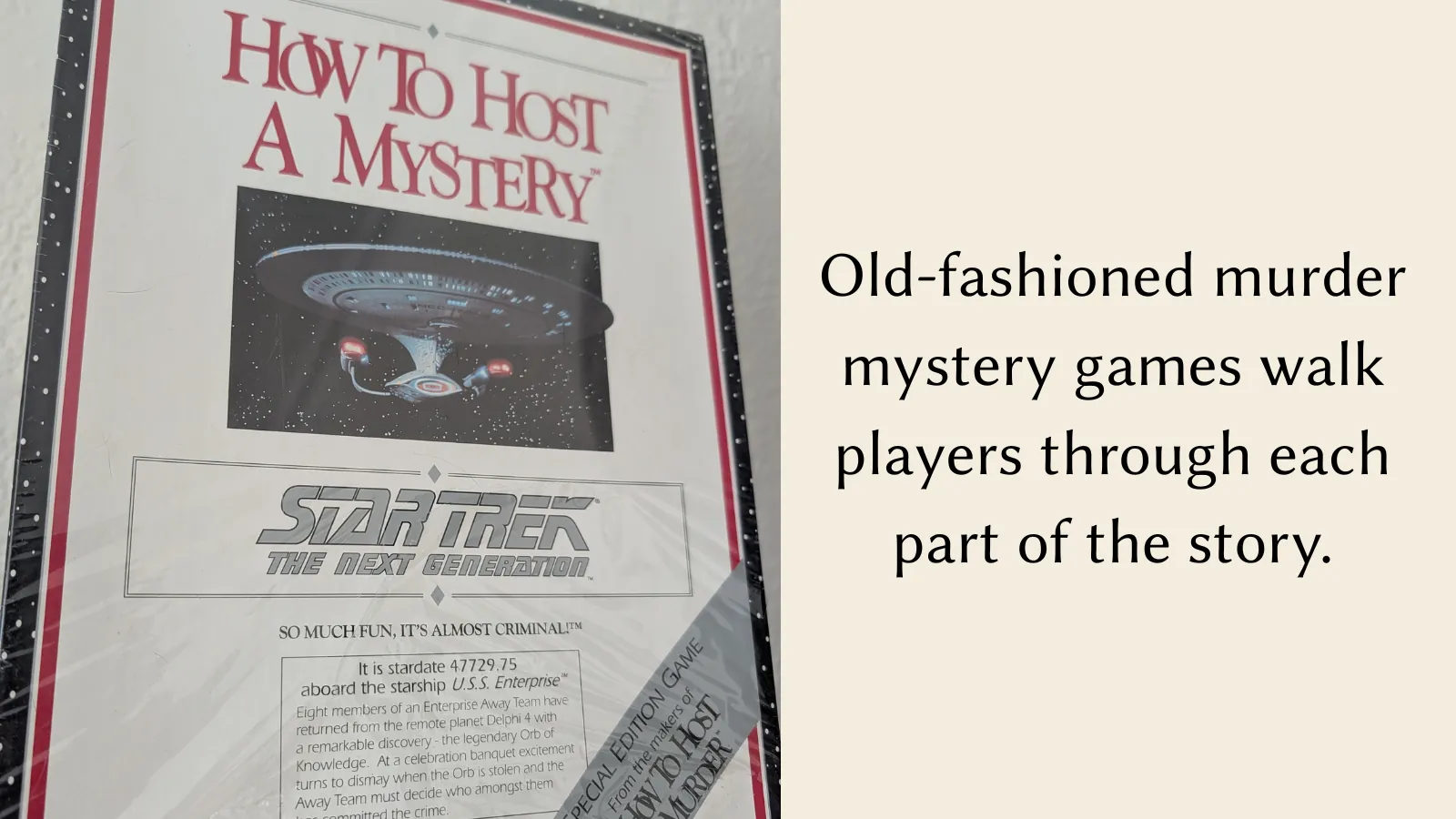
The classic boxed kits from the 1980s and 1990s were didactic. They told each player exactly what to say and when. Clues were hidden from everyone until the round that required them. If you've played How to Host a Mystery or Pasta, Passion & Pistols, you know the style.
That design is genuinely clever. It made murder mysteries accessible to a huge audience, including people who'd never touch a tabletop RPG. Hand someone a script and they can't do it wrong.
It's also a real limitation. As a player, I want the freedom to make things up about my character. Invention is what gives me ownership of the role, and ownership is what I try to give the people who play the games I design.
At the far other end sits freeform. I played an unstructured freeform larp at Midwinter Con in Milwaukee that had almost none of the conventions I was used to. It didn't have any character sheets at all. It didn't even have a workshop at the start to build character connections. They gave a setting and we chose a loose role within it. I started as a customer at a noodle shop and ended the game running a campaign to take over the shop as its best employee. I love that style because it's the closest thing to the pretend play you did as a kid. It's also entirely dependent on the players to make their own fun. And for some people that's terrifying. Freeform is a niche. It rewards people who love improv and acting, and it can leave everyone else stranded.
There are tons of new ways to do murder mystery games as an adult. Some have a bunch of structure, like those games I grew up with. Others are invented pretend play (and the mystery part almost always falls flat on these).
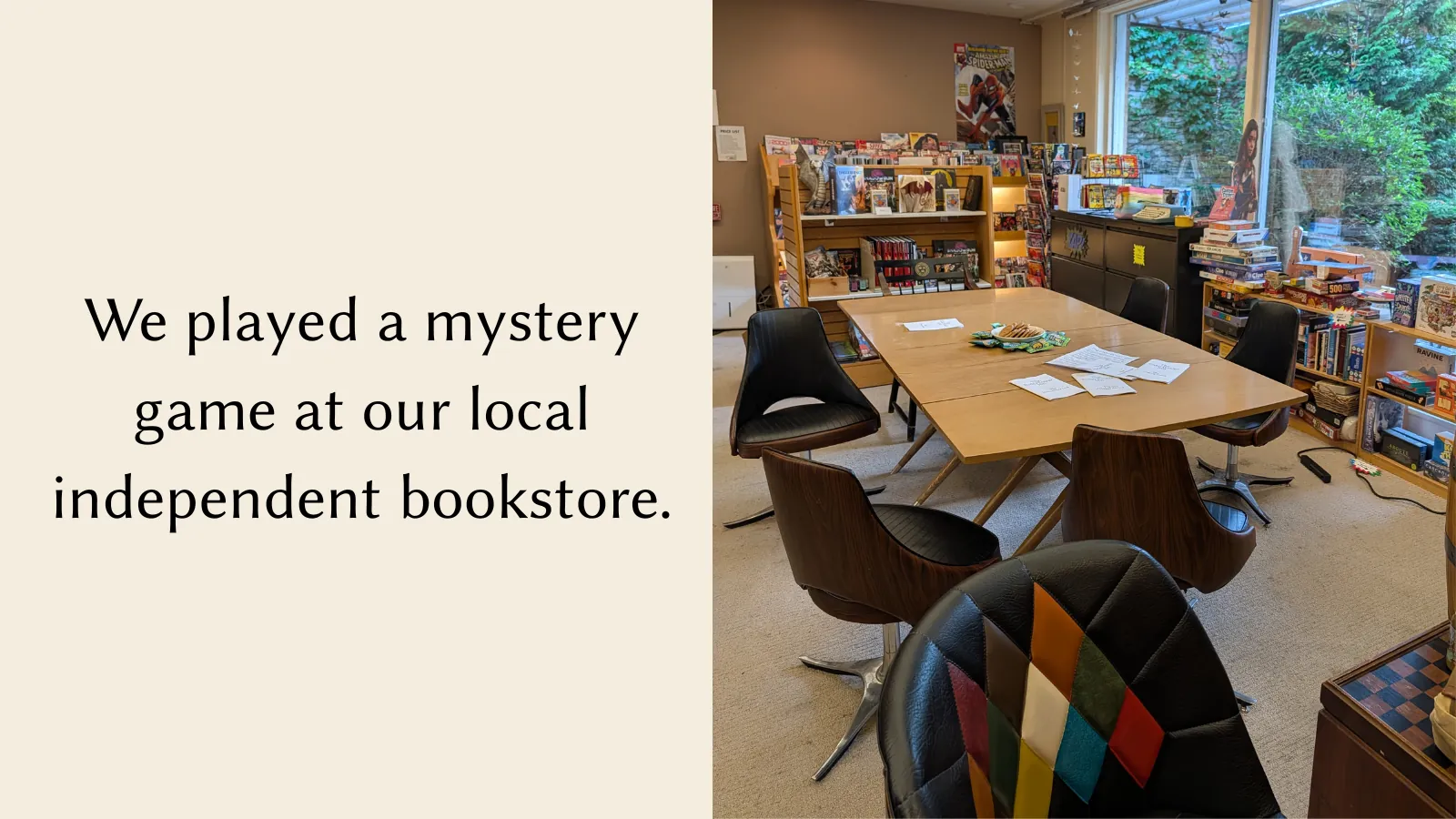
Choose a kit especially for your guests
Think about your specific guest list before you buy anything.
If your group is buttoned up, or nobody's done this before, the old boxed style is the safe call. Scripts and staged clue reveals carry people who'd freeze if you asked them to invent. Thirty-year-old design, still doing its job.
If your group plays a weekly RPG, something like D&D or Monster of the Week, they'll want more. Look for a kit with real structure that still lets players invent details about their own characters. That ownership is the difference between reading a part and playing one.
If your group is full of improvisers and actors, consider freeform. It can be enormous, often really silly, fun. Just know what you're signing up for: the game gives you a situation, and the table does the rest.
Whatever you pick, two things matter at every size of game, and I've found this holds from six players to thirty. Players need reasons to interact with each other, and players need personal goals that matter to them. A kit that provides both will carry a mixed room. A kit that provides neither leaves people unsure of what to do, disconnected from the plot, or worst of all, bored.
One more thing to look for, especially if your group is new to this: some games open with a short workshop to build connections between characters before play starts. Others bake those connections in. Either works. Skipping both is how you get six adults standing around a kitchen island holding paper and waiting.
Murder mystery games for large groups
Past about thirty players, you're not shopping for a boxed kit anymore. You're looking at a larp built to scale.
Events past 30 players are enormously fun and often go well beyond a single murder mystery. The mega-games I've played have involved politics, royalty, and alien invasions. A murder can be the thing that kicks the night off rather than the whole night, and with that many people in a room, the politics take over anyway.
What we make at Autumnal Games
We publish games built around that same idea of ownership. None of them is a murder mystery, and none of them matches a boxed kit. Not yet. But they serve the same room, and if you're the kind of host who throws a murder mystery party, these are the ones I'd point you toward next.
Crypt Kickers is a free autumn committee larp for 4 to 6 players. There's no murder to solve. It's a parlor larp, and it's the game I'd hand a group that has never larped before, especially around Halloween. It won the Max Gladstone Special Judge's Choice Award at Golden Cobra 2021. The judge wrote that the roles are clear and the rules straightforward, with conflict real enough to create honest friction while the stakes stay light enough for hijinks. He also noted it would work well online with very little prep. It's a PDF. It costs nothing. If you want to find out whether your friends will take to this kind of play before you spend money on a kit, start here.
Fortunes: The Tarot Card Storytelling Game is a storytelling game played with a tarot deck, best with 4 to 5 players, though it also plays solo or with fewer. I wrote it and playtested it with story-game devotees and with people who'd never played a story game in their lives, because it had to work for both. Charles Huth did the art, and his work is seen through many of the earliest Autumnal Games projects. This one is available as a hardcover, a zine, and a PDF, with details on the product page.
The Ink & Blood Dueling Society Doesn't Exist is a paperback about a hidden world of writing duelists, which is the world I come from. Writing duels work solo, with two people, or as a public event. The public, secret-society version is my favorite. The book is available online and in stores, including Goblin Market in Chicago and Secret World Books in Highland Park, Illinois. Or ask your local indie bookstore to order it for you. They can.
Buy for the people on your guest list, and give them characters with real reasons to talk to each other. Somewhere in a box, I still have the mystery we wrote for Villandry. One afternoon on the grass in Tours, and I'm still writing about it twenty years later. That's what these games can do.
Murder mystery party kit questions
What is the best murder mystery party kit?
Arsenic and Lies is the best overall option right now. It's a card-based game, it needs no game master and no prep, and it runs a full mystery in an evening. That may change with the growth of jubensha and jubensha-style games in the US.
What is a murder mystery party kit for adults?
A kit gives your group the characters, clues, and structure to play out a murder mystery at a party. They range from fully scripted boxed sets that tell each player exactly what to say, to freeform games that hand you a situation and let the table do the rest.
How much does a murder mystery party kit cost?
Old How to Host a Mystery boxes on eBay run about $15 to $50 including shipping in the US, and there are many more from other brands for $10 to $20 including shipping. A new card kit like Arsenic and Lies is $25 plus shipping, with a cheaper print-and-play PDF.
Where can I buy a murder mystery party kit?
Estate sales, eBay, and the game designers themselves. eBay is where the old boxed games live, and buying direct from designers is how you find the newer independent ones. Big box stores carry them occasionally, which is always a surprise.
What's the best murder mystery kit if nobody has done this before?
The classic boxed style is the safe call. Scripts and staged clue reveals carry people who'd freeze if you asked them to invent, so hand someone a script and they can't do it wrong. How to Host a Mystery and Pasta, Passion & Pistols are examples.
Are any murder mystery kits worth avoiding?
Some of the 1990s boxes are worth skipping if you're playing with friends. They're usually structurally sound, so you'll figure out whodunit, but they're also super uncomfortable. There's an <a href='https://www.imdb.com/title/tt1535367/'>episode of The Office</a> where they play one, and it's a pretty good example of how to use a boxed murder mystery right.
How many players do you need for a murder mystery party?
Most kits are built for small groups. A card game like Arsenic and Lies runs 5 to 10 players, and the old boxed sets tend to sit in the same range. Bigger events scale well past thirty players.
Is there a murder mystery kit for large groups?
Events past 30 players are enormously fun and often go well beyond a single murder mystery. The mega-games in that range involve politics, royalty, and alien invasions. At that size you're no longer shopping for a boxed kit. You're looking at a larp built to scale.
How long does a murder mystery party take?
Plan for an evening. A card-based kit like Arsenic and Lies runs about three hours.
Are there free murder mystery kits for adults?
Free print-and-play mysteries exist, and a used boxed game off eBay can run you as little as ten dollars if free isn't a hard requirement. If what you want is a free party game for a group that has never done this before, Crypt Kickers is a committee larp, not a murder mystery, but it serves the same room and costs nothing.

Jim makes games and events that invite people to embrace a shared fiction.
More game guides
The Best Social Deduction Games by Group Size
The best social deduction games by group size, from two players up to a full table, picked by a game designer who has run them at conventions for years.
Halloween Party Games for Adults
A game designer's Halloween party games for adults: Snap Apple, Snap Dragon, Dread, Crypt Kickers, and Fortunes, with setup, fire safety, and run times.
What to Expect at a Murder Mystery Party
What to expect at a murder mystery party, from a game designer, host, and guest: how characters work, how much prep, and whether you have to act.
Why I Use Artifacts in Games
An artifact game gives players something tangible and on-theme to interact with. Here's what artifact games are, why they work, and where to find them.
Family Reunion Games That Actually Get People Talking
Family reunion games from a working game designer: icebreakers, a hilarious price-guessing game, genealogy trivia, outdoor picks, and free printable options.
Halloween Party Games for Kids, Teens, and Adults
Halloween party games from a working game designer: Snap Apple, Snap Dragon, fortune telling, a tarot game for teens, and outdoor games for big crowds.
How to Write a Murder Mystery Party
Start with the setting, then write the culprit. A game designer walks through writing your own murder mystery party, using the one he's playtesting next week.
How to Plan a Murder Mystery Party (Games, Planning, Recs)
A game designer's guide to planning a murder mystery party, from small friend groups to full LARPs. Themes, player counts, safety cues, and games that work.
Want to try the style of thinking before you commit to a party? Solve a free murder mystery puzzle.